Monday, May 20, 2013

Cooking up the Belgian Chef's Jacket

Bloggers, do you feel guilty when it's been a month since your last post? I do! The reality is that there really hasn't been much time for sewing.


When I'm not out llama trekking with my son in the Smokey Mts.....


I've started building a small sailboat. Don't ask!


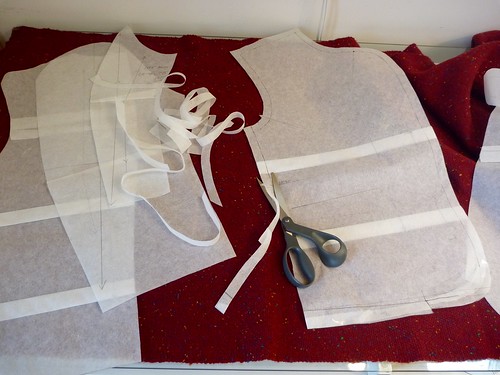
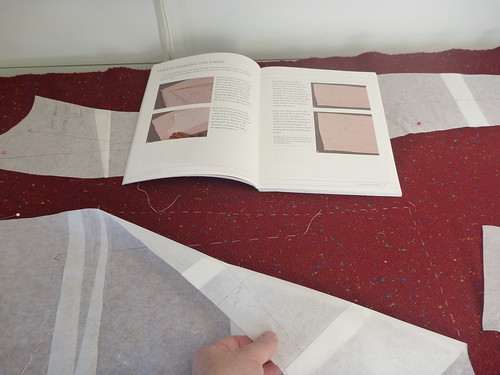
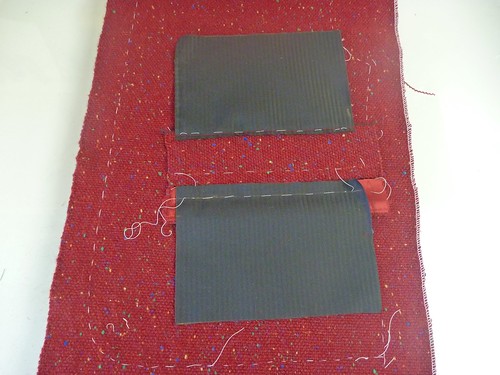
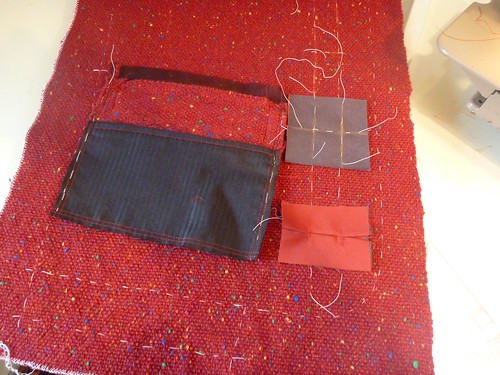
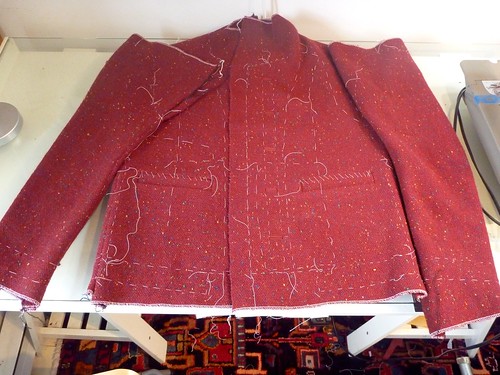
Anyway, today I decided to tackle the muslin of the chef's jacket. I'm considering this for the purple velvet that I picked up in San Francisco. It felt really good to be back sewing again. I traced all the pattern pieces onto my Swedish tracing paper as usual. For fabric I'm using someone's Christmas tablecloth that I picked up at Goodwill for $1.99. Yard for yard, Goodwill is the best source for muslin material anywhere.

I'm always glad to be making a muslin because it helps me discover a pattern's quirks, and this one has a few.


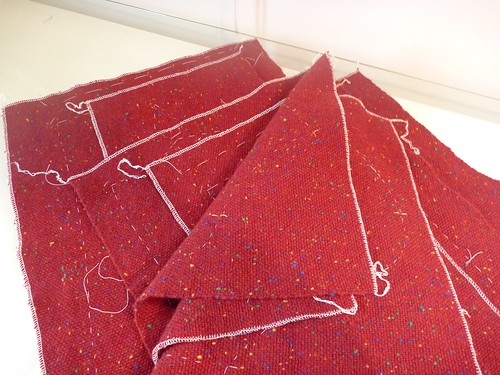
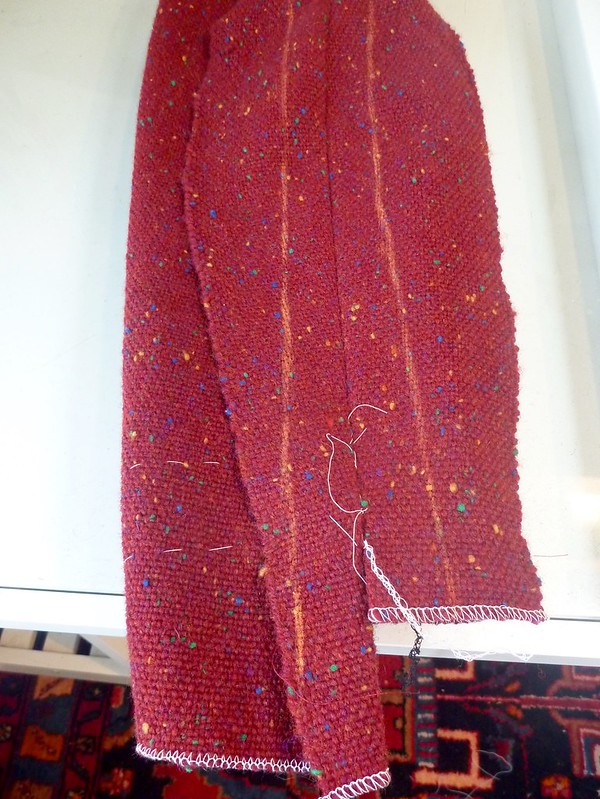
First is the sleeve contruction. There's a two piece sleeve, but the undersleeve is just a wedge shape. Interesting how it doesn't go all the way to the cuff, like on a man's suit jacket. There was some easing required to make the pieces align (good to know ahead of time), and the overall shape of the sleeve is quite pleasing. The instructions call for flat felled seams everywhere, but I won't be going that route. Topstitching and velvet? Um... No.


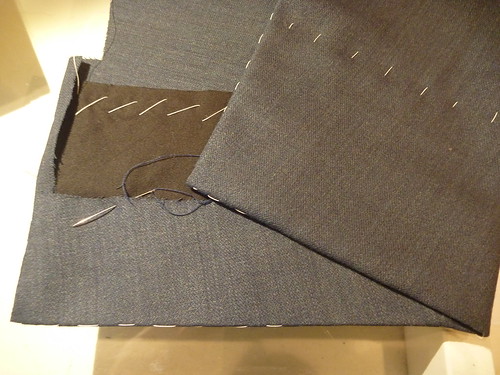
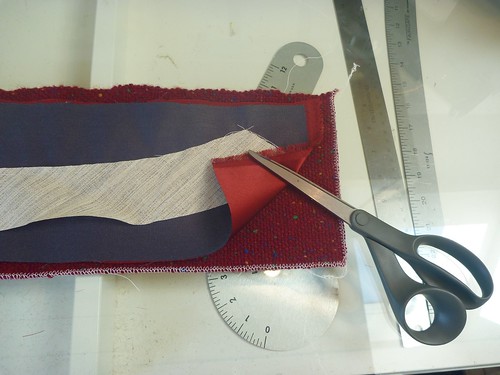
The turned up cuff is really a facing that's edgestitched into place. I don't have a lot of material to work with, so this could potentially be a contrasting fabric. Just a thought at this point. The whole junction of the sleeve seam and cuff is really awkward and messy. Yet another instance where I'm glad that I'm making a muslin. My plan is to line the jacket which should make this area neater. It will just take some thought and planning.


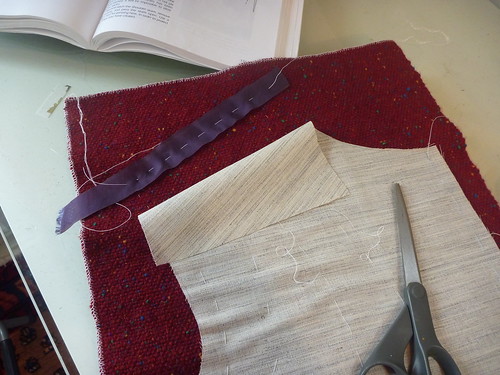
Man, there are some curvy seams on this jacket! Here I'm attaching the center front panel to the side front panel. This is really the critical design element of the whole piece, so it has to turn out well. I eased the center front by pulling up a thread. It worked great on a tablecloth, but will it work on velvet?

The rest of construction was straighforward. I have to say that this pattern is very well drafted, and the instructions are clear and easy to follow. The collar fit in perfectly and the sleeves were a breeze to set. It's always nice to know that some things will be easy down the road!

Next post I'll try it on. Cheers!

Sunday, May 19, 2013

Handmaker's Factory -- Maker Men


I was truly flattered when Nichola, of Melbourne Australia no less, asked me to participate in her series, Maker Men. Afterall, I'm just a crazy man making my own clothes in the middle of nowhere on the coast of Maine.

So if you want to know more about me here's the link. As you'll see, I'm in with some pretty illustrious company! I also hope you'll consider joining Handmaker's Factory. The recent tragedy in Bangladesh makes the mission more poignant than ever.

http://www.handmakersfactory.com.au/Blog/tabid/222/articleType/CategoryView/categoryId/8/Meet-the-maker.aspx

Saturday, April 6, 2013

The Shopping Spree

Is a trip to San Francisco complete without a visit to Britex? I think for most sewists the answer is a resounding "NO"!


For those of you who have never been and are curious, here's my country bumpkin impression. It's a four story "townhouse" of luxury fabrics in the posh Union Square district of the city. It's surrounded by every luxury brand emporium that you can name. Every floor is well staffed with sales associates that are eager to help you. The selection and the prices can be totally mind blowing.


Photography is not allowed in the store, so here's a little rundown (with images from the internet). The first floor is primarily solid fabrics all arranged chromatically from floor to ceiling and from the front of the store to the back. Think ... walking into a fabric rainbow. If you're looking for a specific shade of a specific color, this is your nirvana. The prices are all discretely hidden on tags tucked into the ends of the bolts. Pull the tag if you dare.

The second floor, as I recall, is mostly prints. Keep in mind that I'm shopping from a menswear perspective, so I tend to "glaze over" when there are lots of colorful prints around. Amidst the prints there's a large selection of traditional cotton shirting,including Liberty of London. Drool worthy.


Notions are on level 3. What does it say about you when you get excited about thread? Buttons? Milliner's needles?

Last stop, level 4 is the bargain "basement". Yes! This is where I belong. Everything is well organized here. All the remnants are arranged by fiber type, and everything is as neat as a pin. The staff are also wonderfully helpful, even for those of us who are "dumpster diving" looking for a deal. I saw some beautiful things up here.

So what did I splurge on ???


I picked up this almost 2 yard remnant of velvet on Level 4. (Sorry, but the first two floors of Britex are totally out of my league.) It's not quite enough for a jacket, which I would have loved, but more than enough for another Victorian vest, or two. It's really hard to capture the iridescent quality of this fabric, which alternates between purple and a loden green.


Here it shows a little better, falling over the edge of my work table. It all depends on the light and which way the nap is running. Funny story, I took the fabric to the button counter and couldn't understand why the sales associate kept pulling green buttons while I was looking at the purple ones. From her vantage point the fabric looked totally green! In the end I went with her green choice.


I also picked up an assortment of silk buttonhole twist. I really want to make some handworked buttonholes this year. They look so amazing, so Jermyn Street, and I'm in total awe of the guys I see doing them. I just need to get up the courage. Of course having the right materials to work with is key, and I'm not going to find this at JoAnn's. So... this little splurge was a no-brainer.


Lastly, I couldn't resist these felt toggles!


Each one is made with a roll of felt. Love!!!! I don't really have a plan for them yet, but I just couldn't resist. I also knew that I would kick myself forever if I passed on them.


Oh, and after you shoot your wad on expensive fabric you'll be needing cheap eats. I'd suggest Curry Up Now on Valencia in the Mission.

Happy sewing and shopping to you all!

Thursday, March 28, 2013

Dad's Spring Break Photo Shoot

My trip to the west coast was fantastic. It was just the tonic that this winter-worn man needed. Birds singing, flowers blooming, sunshine, PLUS the chance to hang out with my amazingly talented and beautiful daughter.

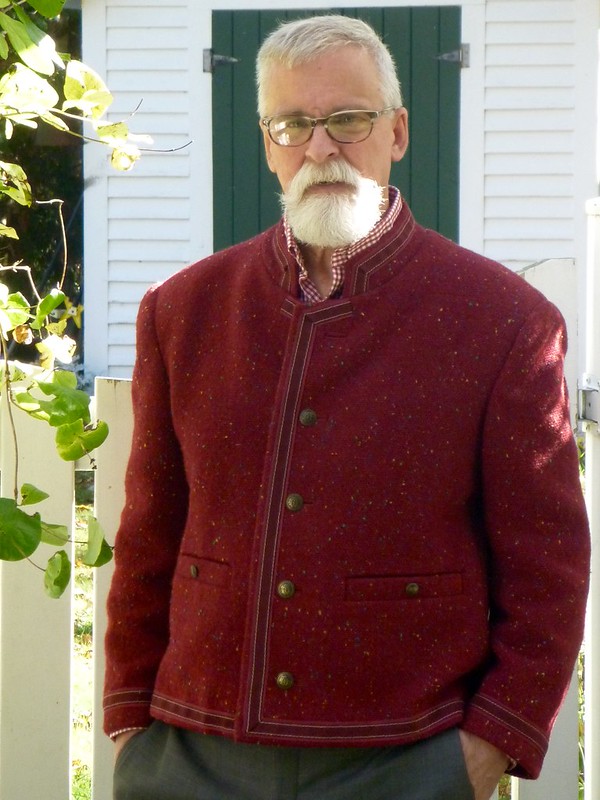
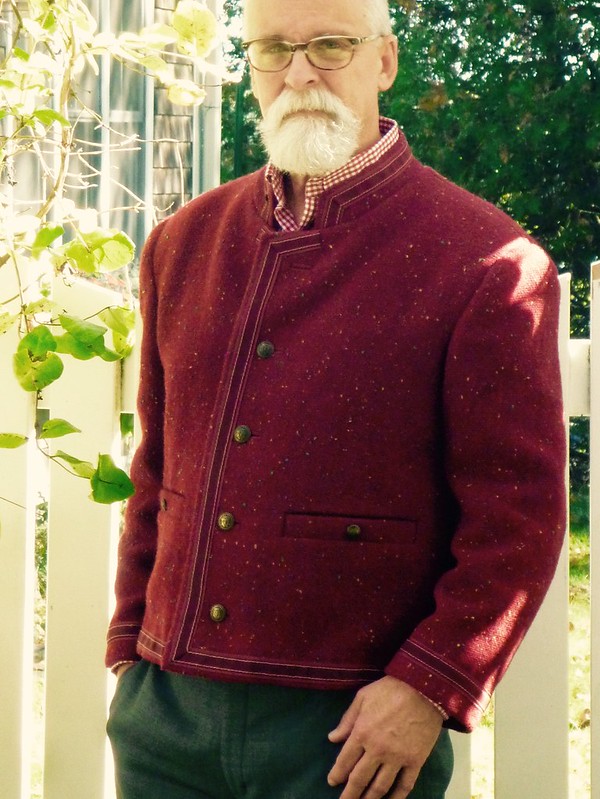
My coat proved to be very travel worthy. I wore it on the plane both coming and going, and never felt that I was wearing a wrinkled mess. In these photos it hasn't seen an iron since leaving Maine. It's been worn in the car for an hour (it was 27 degrees when I left), on a bus for two more hours and in the air for at least six. So practical, Yes..... but stylish? Get this...

I'd only been in the Portland bus/train station a couple of minutes when a young guy walked by and said "nice coat!". Jackpot! When another guy comments on your clothing you know you've nailed it.


These photos were all taken at Lake Merritt in downtown Oakland, CA.


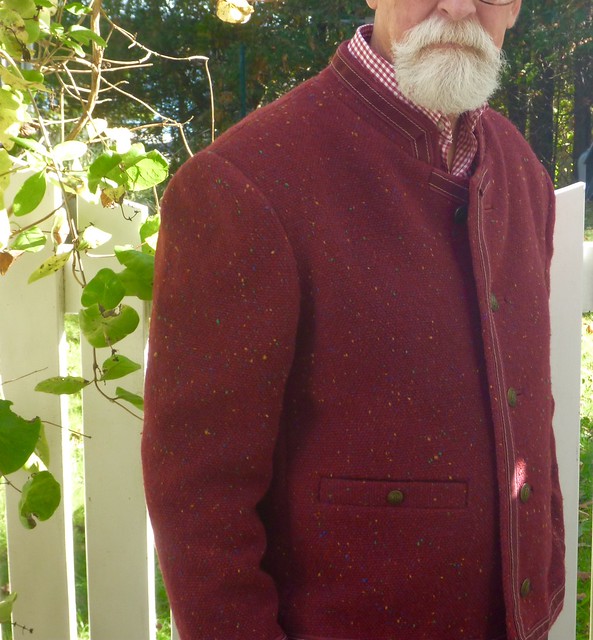
The slightly curved double piping pockets really do stay closed!


I'm really pleased with fit across the upper back. There's a lot of waist suppression to this pattern, which makes for a flattering fit.


So ends my journey into the lapel-less jacket, a style that I previously thought was completely ridiculous. I like it so much that I'm thinking about making it again in a lighter fabric and with less structure. Red linen maybe.

Now if only the snow would melt (sigh).

Happy Spring sewing to you all!

Thursday, March 21, 2013

Banging out a shirt. -- and, what's with buttons?

Sorry, no photo shoot of the new jacket yet. I'm headed to the west coast in a couple of days to meet up with the fabulously talented headmistress of the Foster Monster's Orphanage. While she's not busy disciplining her unruly gang of monsters, I'm hoping she'll agree to be my photographer. Plus it will actually look like Spring there. The alternative is me trying to look happy standing ankle deep in snow.

So, while I have a little free time I've decided to make myself a new shirt for the trip. Something about traveling makes me want to have something new to wear. I'm probably the slowest sewist in the universe, so to get this made in three days is really an accomplishment. I'm really pleased with the result, and think it will be perfect for mid to upper 60 degree days.


This is a cotton lawn that I purchased on sale through Denver Fabrics for $4 / yard. At 54" wide it took just a little over 2 yards. I have also seen this fabric in NYC. Some of the more cramped fabric stores in the garment district actually have bolts of fabric tumbling out onto the sidewalks. It's their free advertising. Sometimes it makes me think "hmm, this place looks interesting", other times I think "man, I don't think I can even squeeze in there". Anyhow, I spotted this fabric on the sidewalk once and walked away. When it showed up on sale at Denver Fabrics I decided to give it a try, and I'm glad I did.

This fabric has a wonderful "floaty" quality. I don't sew for women, but this would make a great summer maxi-dress. The diagonal pattern really adds a sense of movement. The color is really more pink / coral. My camera is making it look more orange.


I wanted to preserve the diagonal pattern of this fabric without agonizing over matching, so I opted for a placket front. This allowed me to cut the front on the fold. The placket is just the David Coffin sleeve placket writ large. His book on shirtmaking gives all the instructions on how to draft and sew it. It's really a great bit of sewing origami, and surprisingly easy to do. You will never fear making a placket again. I interfaced the placket, collar and stand with Pro Woven Shirt Crisp from Fashion Sewing Supply. It's simply the most amazing stuff! (and this, from a guy who resisted fusibles forever!) You will swear that it's a store bought shirt.

The real challenge of this shirt was, of all things, the buttons. My only sources locally are JoAnn's and Wal-Mart. I decided that my best option was JoAnn's. They really only had one option for a man's buttondown shirt. The issue is finding the small buttons for the collar. What JoAnn's had was "OK" but really didn't go with my fabric. If I had been looking for something gold, with rhinestones or shaped like cupcakes I would have been all set. It's funny how something so simple can be so frustrating. The other kicker is that a set of buttons that I really didn't like cost $6. They're buttons!

So, I turned to the biggest selection of buttons in my area....


That's right, Goodwill. I can buy a shirt for $4.99. They have a huge selection so it was easy to find the "right" buttons. I ended up with an X-large flannel shirt that can be used for either a nice dust rag or perhaps coat pocketing in the future.


All of these for $4.99. Almost double the amount needed.


Plus, I found this great 50's lampshade for $1.99. Guess who's been watching too much MadMen!

Happy sewing (or thrifting), everyone!

Saturday, March 9, 2013

Tailoring Geekery ... Conclusion

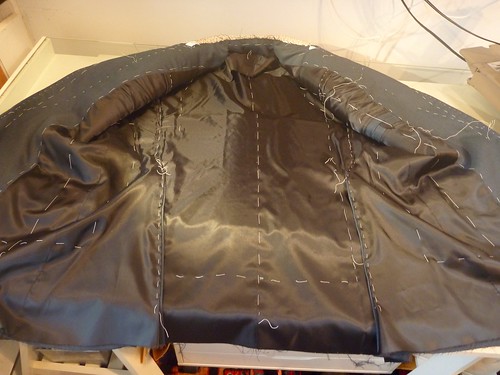
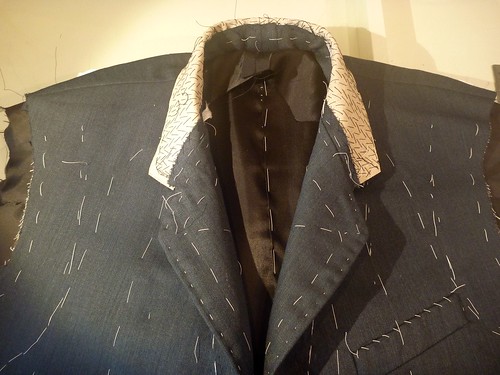
Moving forward, it's time to attach the lining to the jacket. Unfortunately, I don't have many photos of this process. I was so focused on the sewing that I totally forgot about the camera!

In all honesty I was dreading this step, but it ended up being much easier than I anticipated. After placing the right sides together, the jacket and lining are basted together with a line of basting stitches placed down the center of the twill tape. The machine stitching is placed just next to the tape. Cabrera suggests 1/16 " away. I just went very slowly with this step, making sure not to catch the edge of the tape. The seam is then pressed open and the lining / facing is turned to the inside of the jacket.

From this point the jacket is finished with handstitching.


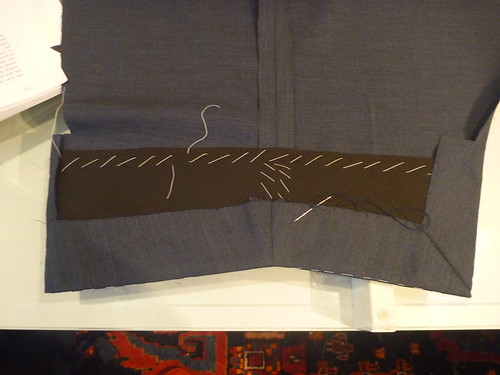
This is my preferred way of hemming, even though it just looks like a huge mess. The hem is 2" deep, so a bias strip of pocketing 2 1/2" wide is placed into the fold of the hem and sewn in place. I backstitched the pocketing to the folded up hem along the line of the pins. (The stitches just don't show up in the photo.) The actual hem stitch is done between the pocketing and the body of the jacket. It's easiest to do this with the hem facing away from you, as shown in this photo. Sewn this way, your hem will be totally invisible. Plus, the hem gets a little extra "oomph" from the added muslin strip, and a little extra body is always a good thing in my opinion.


The disadvantage to the way I've lined this jacket is that the lining isn't anchored to the body of the jacket anywhere. It's just hanging inside. To correct this I've placed a line of invisible stitches "in the ditch" along the front / side seam. The point turner is pointing to the seam. With the seams of the jacket and the lining aligned over each other, a row of invisible stitches is placed starting at the underarm and worked down to the top of the pocket. Problem solved. Now the lining isn't shifting around inside the jacket.

The facing has a similar problem, especially on this jacket since there's no lapel. There's nothing anchoring it, so it wants to roll out. If I were sewing the entire lining by hand, the facing would first have been cross stitched to the inside of the canvas, and the lining would have lapped over the facing. My job is to replicate that. Fortunately it's not difficult.

The facing is pressed into position and then a line of invisible stitches is placed "in the ditch" down through the facing / lining seam. These stitches must catch the canvas underneath, but not go through to the front of the jacket. It's easier to do than it sounds. Still, I keep checking the fronts frequently to make sure I'm not accidentally stitching too deep.

So, there have been a couple of extra steps. But overall, I think it's been much easier than sewing the lining completely by hand.

Now that the lining is better attached to the jacket, I proceed with the vents and hem.


Is there a magic answer to lining? I wish! I just work methodically along. I find it easiest to work the lining from two directions, alternating down the vent and across the hem. It has a way of coming together eventually. It just takes patience and a willingness to fiddle with it until it does what you want it to do.


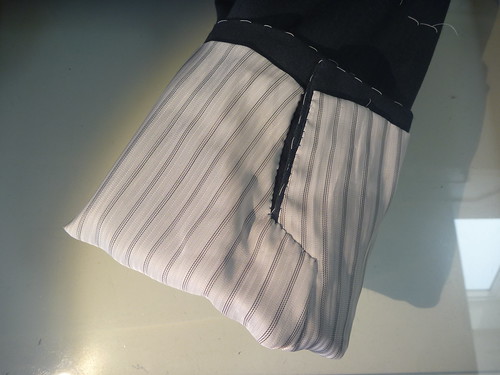
I run the lining close to the edge of the vents and finish it off with pick stitching. I think it's an elegant way to finish the lining. Plus... it's really easy and fun to do!


This is the back pleat after the basting is removed. Lots of wearing ease here.


I added a locker loop to the back neck facing. This helped give some much needed structure to this area. In retrospect I should have interfaced the facing. The last minute pocketing that I added to the lining just isn't substantial enough. A heavy weight fusible would have been perfect here. Ah well, next time. It wouldn't be sewing if we didn't have some regrets, right? It's how we learn and progress, making the next garment just that much better.


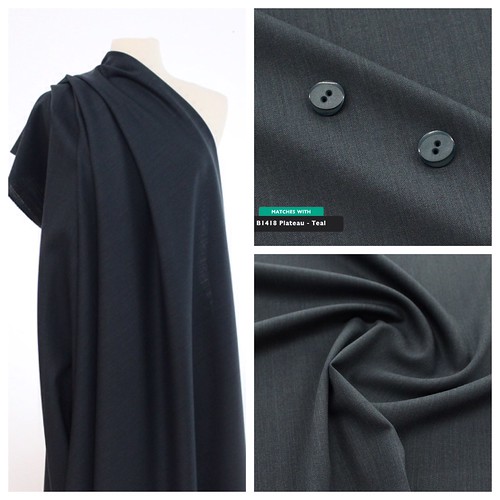
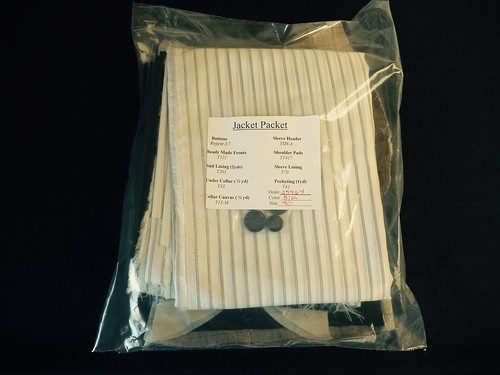
I wasn't wild about the buttons that came with my B Black & Sons "jacket packet". Other than that, the packet was fantastic. Two thumbs up! There was nothing skimpy about it. I have a nice chunk of both pocketing and lining left over. Unfortunately the color of the buttons just didn't work with my fabric. I also thought they were a little too shiny. This was the best I could do at JoAnn's in a pinch. Someday I hope to find something a little lighter, but these are fine in the meantime.

So this brings me to the end of my tailoring geekery. Thanks for sticking it out with me! I hope to model the new jacket soon.

Thursday, March 7, 2013

Wrestling Match

Things moved ahead so smoothly with the lining that I completely forgot about inserting the shoulder pads. Oh man, what an ordeal. Not that this is a particularly difficult process, it's just that there suddenly seems to be a lot of jumbled fabric sitting in one's lap. It starts to turn into a wrestling match.


First, all the layers of the armscye seam allowances are basted together so that it acts as a unit. There are a lot of layers here. Two layers of the fashion fabric, the canvas and the pocketing reinforcement strip. It's also, as you can see, a huge frayed mess.


Now the real wrestling begins. The shoulder pad is placed in position at the edge of the armscye seam allowance. Thankfully, the pad is notched where it should match the shoulder seam. Next, the canvas, which up until now has been basted to the jacket front, has to be peeled back while holding the pad in place. I try to preserve as much of the basting as possible so that the shape of the jacket front is maintained. It becomes a lot of work and attention paid to a very confined and awkward area. Don't get discouraged.


Next, as impossible as it seems, the canvas is pad stitched to the shoulder pad going through all the layers. At this point the shoulder pad is actually curving in the opposite direction that it will eventually go, so the jacket should be frequently turned rightside out to check that all is going well. Suddenly, a little jacket has turned into what seems like an octopus. The first time through this process was, in all honesty, a nightmare. Man vs. fabric. The second time was a piece of cake. It's amazing how quickly we can learn some of the more challenging techniques of tailoring.


Lastly, a sleeve head is sewn in. It helps fill out the top of the sleeve so that it will "fall" without wrinkles. Thankfully, this is easy to do and goes quickly. The edge of the sleeve head is placed even with the armscye and shoulder pad edges. It starts at the front notch and goes up and over the shoulder to the back. I back stitch it into the seam with a thread that will match the jacket. The stitches should not be visible from the outside, which would be pretty difficult to do considering all the fabric layers at this point.


So here is the final shoulder construction in all its layered glory. From the top down --shoulder pad, canvas, fashion fabric and sleeve head. I won't lie, I'm sick to death of working on these shoulders. But... I've turned the jacket rightside out and can tell you that all the effort has been worth it. They look great! Time for a break before attaching the lining.